
Surveillance and Observation: How It Works, Limits and Cost
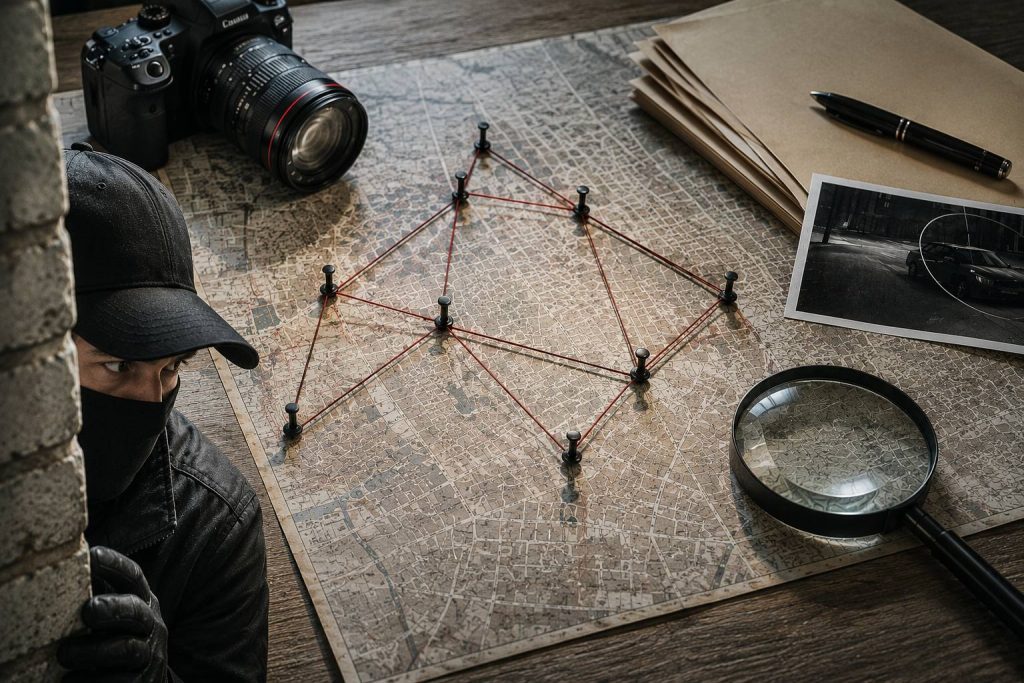
Surveillance is the least cinematic part of investigative work and, at the same time, the part that decides most cases. No car chases, no disguises — just patience, careful planning and documentation that will hold up later. This article explains how professional observation actually runs, what it can deliver, and where the legal limits lie in Germany. It is not legal advice.
When observation is the right tool
It makes sense whenever behaviour has to be established that takes place outdoors and repeats with some regularity. Typical grounds: suspected secondary employment during sick leave, feigned incapacity for work, passing company information to a competitor, stock losses tied to a particular shift, questions around custody and maintenance, and suspicion of an extramarital relationship.
It makes no sense when all that exists is a vague feeling and nobody can say what exactly needs to be shown. Observation without a concrete question produces hours, not answers.
Preparation decides the outcome
Before the first day in the field comes reconnaissance: daily routines, home and work addresses, vehicles, habitual routes, parking, the traffic layout of the area. A great deal of that can be assembled in advance from open sources — this is where OSINT research feeds directly into surveillance planning and saves expensive field hours.
Then the brief is sharpened: which question must be answered, what time frame is realistic, what budget is available, and how we will know the assignment is complete. Those four points go into writing before anyone gets into a car.
The operation
Depending on the situation, one to three teams work on foot and mobile, rotating vehicles and personnel so that no face is noticed twice. Everything is documented: time, place, observed behaviour, accompanying persons, registration plates — supplemented by photographs taken in public space. Those raw notes become a chronological report that avoids interpretation: observation and assessment are kept strictly apart.
A realistic expectation: a single day in the field rarely produces the decisive proof. A result usually becomes solid over several days, because only then does a pattern emerge — and a pattern is what convinces.
The legal limits
Observation in public space is permissible where there is a legitimate interest; the processing of data must be proportionate and serve the specific purpose. Strictly prohibited, by contrast, are images from the most personal sphere of life — looking into a home is off limits, and section 201a of the Criminal Code draws a hard line there. Equally impermissible: covertly attaching GPS trackers to other people’s vehicles and listening in on conversations.
Crossing those limits produces not only unusable material but a criminal case of one’s own. A reputable agency therefore sometimes declines a job — and explains which other route leads to the goal. The service in full: surveillance in Hamburg and northern Germany.
Observation and polygraph together
The two instruments answer different questions. Observation shows what happened; a polygraph examination shows whether a person is giving a truthful account of it. In corporate cases the sequence is often observation to narrow the field, then an interview with a test to clarify — or the reverse, where the circle of people involved is large. Our article explains how a test runs.
Frequently asked questions
What does surveillance cost? Billing is by field hours per operative plus travel costs. After the initial consultation you get a realistic range rather than a flat package that later breaks apart.
Will the observed person find out? Not during the operation. Data protection rights of access may arise later; we discuss that openly in advance.
Can I use the material in court? Lawfully obtained documentation is regularly usable in civil proceedings, with the weighing left to the court. Clarify this with your lawyer.
How quickly can you start? In urgent matters within 24 to 48 hours of the assignment being placed.